Bankable retail development in Iowa is not driven by optimism — it is driven by underwriting discipline.
Before a shovel hits the ground, lenders and equity partners evaluate one central question:
How much risk is baked into this site?
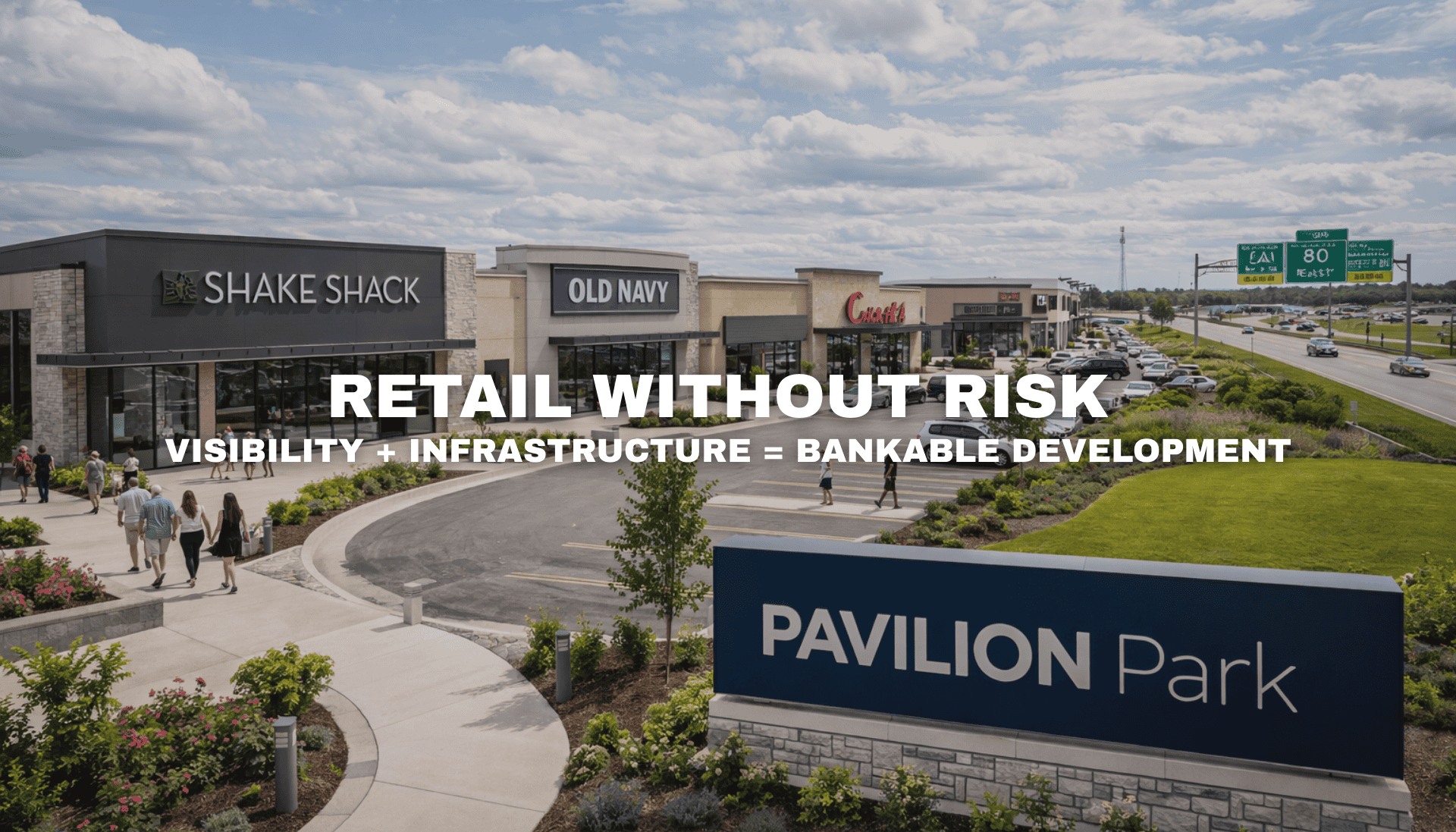
In West Des Moines, Pavilion Park presents a rare alignment of the two factors that reduce underwriting friction more than any others:
Visibility and infrastructure.
When these two components are already in place, financing becomes smoother, tenant recruitment accelerates, and long-term valuation strengthens.
The First Risk Filter: Traffic & Visibility
Retail underwriting begins with traffic patterns.
Lenders analyze:
- Daily vehicle counts
- Corridor strength
- Long-term infrastructure plans
- Access simplicity
- Trade area draw
Pavilion Park benefits from:
- Immediate proximity to I-80 (55,000+ vehicles/day)
- Direct connectivity via Grand Prairie Parkway
- Clear frontage and signage opportunities
- Positioning within a growing Dallas County corridor
For underwriting teams, that visibility translates into measurable exposure — not speculative assumptions.
Retailers want to be seen.
Lenders want tenants that succeed.
Visibility bridges that gap.
The Second Risk Filter: Infrastructure Readiness
Raw land introduces variables.
Uncertain utility timelines.
Unclear stormwater requirements.
Road access negotiations.
Permitting unpredictability.
Each of these factors introduces risk premiums into loan structures.
Pavilion Park reduces those variables through:
- Completed roadway access
- Installed utilities
- Established stormwater planning
- Master-planned zoning alignment
Infrastructure already in place lowers development timelines and reduces contingency reserves — both of which improve financing terms.
In underwriting language, that equals predictability.
Why Predictability Increases Capital Access
Retail development does not fail because of concept alone — it fails when timing and capital structure misalign.
Sites that offer:
- Clean access
- Proven corridors
- Growing rooftops
- Utility readiness
… are easier to finance because the margin for surprise shrinks.
For West Des Moines retail investment, Pavilion Park checks the underwriting boxes that matter most:
• Traffic clarity
• Growth trajectory
• Parcel flexibility
• Corridor momentum
This creates what lenders call “bankable conditions.”
The Corridor Effect on Valuation
Retail real estate valuation strengthens when part of a larger, coordinated corridor.
Grand Prairie Parkway is evolving into a commercial spine connecting:
• I-80 interchange
• Pavilion Park
• Residential expansion
• Northward growth toward Waukee
When retail anchors position within structured corridors rather than isolated pads, underwriting models often show stronger long-term appreciation potential.
Why?
Because corridor density compounds value over time.
Pavilion Park sits at the southern gateway of this emerging growth spine.
Tenant Stability = Lower Risk Profile
Retail lenders evaluate not just site conditions but tenant quality.
Sites that attract:
- National brands
- Creditworthy regional operators
- Essential-service tenants
- Mixed-use adjacency
… present lower perceived volatility.
Pavilion Park’s master-planned scale allows for tenant clustering, rather than piecemeal leasing. This supports:
• Stronger co-tenancy relationships
• Balanced tenant mix
• Cross-traffic reinforcement
• Long-term leasing resilience
That stability improves underwriting assumptions across debt and equity structures.
Interstate Frontage Without Interchange Chaos
Pure interstate interchange sites often suffer from:
- Congestion bottlenecks
- Limited pedestrian environment
- High acquisition pricing
- Long-term traffic volatility
Pavilion Park benefits from I-80 adjacency while maintaining structured access and master-planned design.
This balance allows for:
- Strong visibility
- Clean ingress/egress
- Future scalability
- Integrated placemaking
Underwriting teams favor sites that offer traffic exposure without access complications.
The Role of Demographics in Underwriting
Dallas County continues to post strong population growth, particularly west of Des Moines. Underwriting models favor:
• High household income trade areas
• Youth and family density
• Sustained residential permits
• School expansion indicators
Pavilion Park sits within that expanding demographic base — reinforcing retail viability.
Retail follows rooftops.
Underwriting follows rooftops.
And rooftops continue moving west.
Lower Risk = Higher Optionality
When visibility and infrastructure are already secured, developers gain flexibility:
• Build-to-suit projects
• Multi-tenant retail centers
• Hospitality adjacency
• Office and service layering
Optionality improves exit strategy options — whether through long-term hold, refinance, or sale.
Retail without risk is not about eliminating uncertainty entirely — it is about minimizing avoidable variables.
Pavilion Park reduces the variables that matter most.
The Long View
Retail markets evolve. Corridors mature. Parcel availability tightens.
What remains constant is this:
Sites with strong infrastructure and visibility perform better in both good cycles and soft cycles.
West Des Moines retail investment along Grand Prairie Parkway is entering a stage where disciplined development will define long-term value leaders.
Pavilion Park offers:
- Interstate connectivity
- Corridor momentum
- Infrastructure readiness
- Mixed-use flexibility
- Scalable acreage
That combination creates a development environment lenders understand — and are willing to support.
Where Bankable Meets Buildable
Retail underwriting is rarely emotional. It is structured, data-driven, and conservative.
But when a site aligns traffic, infrastructure, demographics, and corridor growth, it becomes something more powerful:
Financeable. Scalable. Durable.
Pavilion Park is positioned as exactly that kind of retail development opportunity.
Not speculative.
Strategic.