Commercial growth is often described as a one-directional movement — outward from a city center, gradually expanding into surrounding areas.
But along Grand Prairie Parkway, that model no longer applies.
Growth is now happening from both directions at once.
- From the south: West Des Moines and Interstate 80
- From the north: Waukee and the expanding Kettlestone Lakes district
At the center of that convergence sits Pavilion Park — positioned not just as a gateway, but as a meeting point between two of the strongest growth engines in the region.
The Northern Force: Kettlestone Lakes and Residential Expansion
To understand Pavilion Park’s opportunity, you have to look north.
Kettlestone Lakes is anchored within one of the fastest-growing residential corridors in Iowa. The area is seeing:
- Continued housing development
- Expanding school infrastructure
- Increasing household density
- Strong demographic growth among families and professionals
This creates consistent demand for:
- Retail and dining
- Medical and service providers
- Lifestyle and wellness uses
- Entertainment and community-driven spaces
But as density increases, demand does not stay contained.
It moves.
Southbound Flow: Demand Doesn’t Stop at the Node
Residents in Waukee and surrounding areas are not limited to one destination.
They:
- Commute south toward West Des Moines
- Travel toward I-80 for regional access
- Seek dining, retail, and entertainment across multiple locations
- Move throughout the corridor daily
This creates a southbound flow of activity — one that naturally feeds into Pavilion Park.
Instead of relying solely on interstate traffic, Pavilion Park benefits from:
- Daily local movement
- Repeat community-driven visits
- Increasing exposure from residential growth
Pavilion Park: Where Growth Converges
While Kettlestone builds density and Pavilion Park captures interstate traffic, Pavilion Park’s true advantage is that it sits between both forces.
It captures:
- Northbound interstate visitors
- Southbound residential traffic
- Cross-corridor movement between nodes
This creates a layered demand structure that is stronger than either direction alone.
In simple terms:
Kettlestone generates demand.
Pavilion Park absorbs and expands it.
Why Dual-Directional Growth Is More Stable
Many commercial developments rely heavily on a single source of demand:
- Either local population
- Or regional traffic
Pavilion Park benefits from both.
This dual-directional growth provides:
- More consistent traffic patterns
- Reduced reliance on any single customer base
- Stronger long-term tenant performance
- Greater resilience during market shifts
When one source slows, the other continues to support activity.
That balance is a major advantage.
The Corridor Effect in Action
As both nodes continue to develop, the Grand Prairie Parkway corridor becomes more than a connection.
It becomes a system.
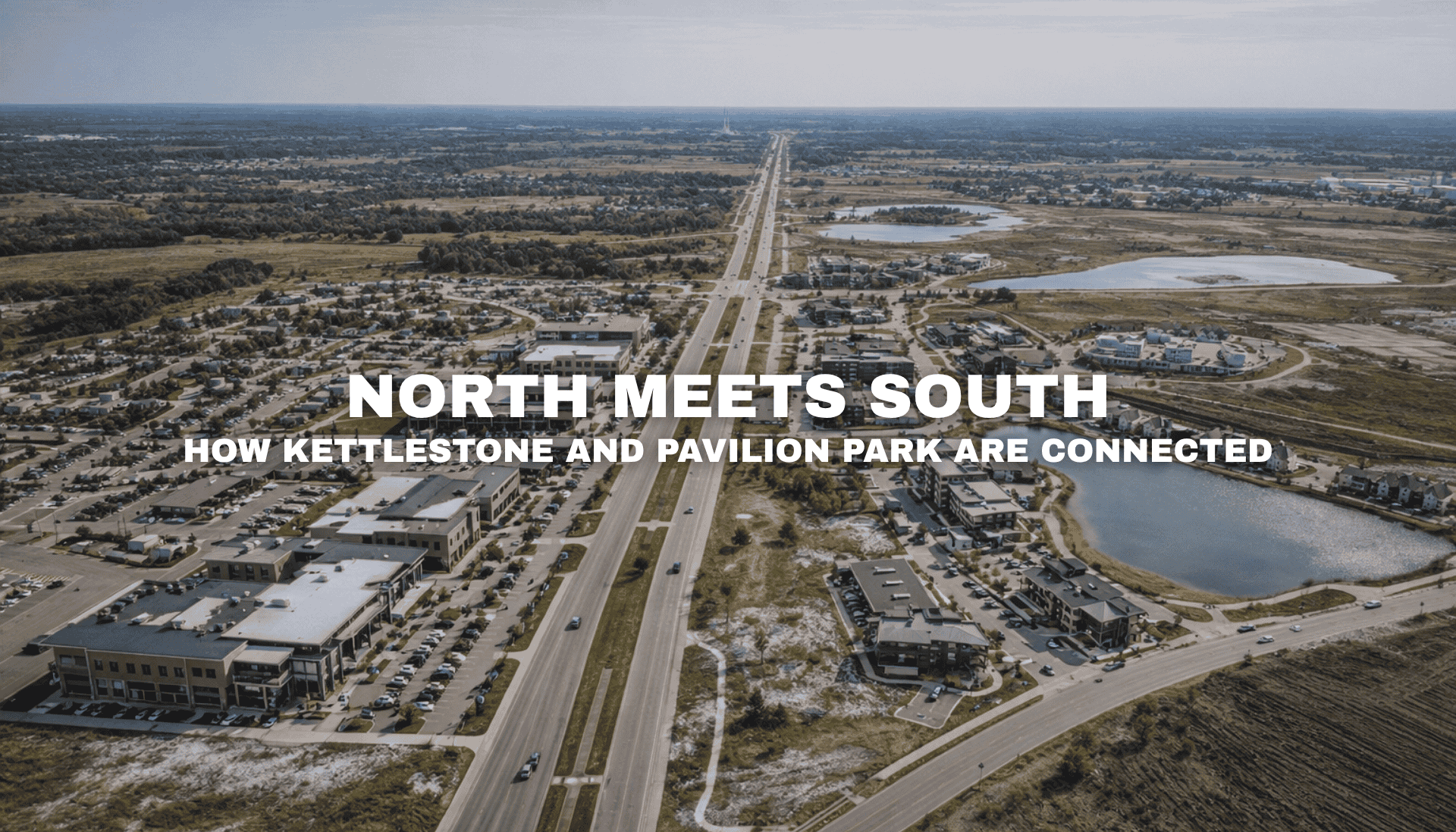
- Pavilion Park anchors the southern gateway
- Kettlestone anchors the northern community
- The corridor between them fills with activity, movement, and opportunity
This creates:
- Continuous commercial flow
- Reinforced traffic patterns
- Increased visibility for all tenants
- Stronger long-term positioning for developers
Instead of isolated peaks of activity, the corridor produces sustained performance.
Why This Matters for Tenants
For businesses evaluating Pavilion Park, the connection to Kettlestone Lakes adds a new layer of value.
Tenants benefit from:
- Interstate exposure at Pavilion Park
- Residential-driven demand from the north
- Repeat visibility along the corridor
- Multiple customer touchpoints throughout the day
This is especially valuable for:
- Restaurants and dining concepts
- Fitness and wellness operators
- Service-based businesses
- Retail brands building market presence
Instead of choosing between local or regional demand, they gain access to both.
A Stronger Story for Developers and Investors
From a development perspective, Pavilion Park’s position within a two-way growth corridor strengthens:
- Leasing narratives
- Investment positioning
- Long-term valuation potential
Developers are not just offering a site.
They are offering:
- Access to interstate traffic
- Access to expanding residential density
- Placement within a corridor that continues to build momentum
This makes Pavilion Park easier to underwrite, easier to market, and more compelling over time.
The Long-Term Outlook
As Dallas County continues to grow, the connection between Waukee and West Des Moines will only intensify.
More homes.
More businesses.
More movement between nodes.
Pavilion Park is positioned to benefit from all of it because it sits where those paths cross.
Not at the edge of growth.
But at its intersection.
Where Two Growth Stories Become One
The strongest commercial locations are not defined by a single advantage.
They are defined by how multiple forces come together.
At Pavilion Park:
- Interstate traffic moves north
- Residential demand moves south
- The corridor connects everything in between
North meets south.
And at that meeting point, opportunity expands.
For tenants, developers, and investors, Pavilion Park is not just another site along the corridor.
It is where the corridor comes together.